
A short story, written by Claude in the spirit of John Williams' Stoner, about the quiet life of an unremarkable frontend developer.
Markup - A Short Storyh1
Introductionh2
If you’ve never read Stoner by John Williams, do yourself a favor and pick it up. It’s a novel about a man who becomes an English professor and lives an entirely ordinary, mostly unnoticed life — and somehow it’s one best books I’ve ever read.
So I sat down with Claude and asked it to write a story in that spirit — about a developer who is deeply, stubbornly average, and who toils in total obscurity, and whose work matters in ways that no one, including him, will ever fully articulate.
Storyh2
David Langford, who spent thirty-one years as a frontend developer at companies whose names you would not recognize, died at his desk in a coworking space in suburban Maryland on a Tuesday afternoon in March of 2037. He was fifty-eight years old. His monitor displayed, at the moment of his death, an unclosed <div> tag. The Slack channel he belonged to did not notice his absence until the following morning, when the standup bot posted its automated prompt and received no reply.
He came to programming the way most people of his generation did — sideways, and without conviction.
He had been a middling student at a middling state university, the sort of young man who drifted through orientation week with a backpack he’d had since tenth grade and a vague notion that he might study communications. His mother, a dental hygienist in Hagerstown, had once told him that he was good with computers, by which she meant that he had fixed the family printer twice.
In his sophomore year, a roommate showed him how to edit the HTML of their dormitory’s intramural sports page. David changed the background color from white to a pale blue, and then he sat and looked at it. He refreshed the page. The blue was still there. It was a small thing, perhaps the smallest thing — but he had reached into the machine and the machine had answered. He changed the blue to green. He changed it back. Something had opened in him that would not close.
He switched his major to Information Systems, a department housed in a building adjacent to the business school that smelled of carpet adhesive and quiet compromise. He was not a brilliant student. He did not build side projects that caught the attention of recruiters. He did not win hackathons. At the career fair, he stood in lines and handed his resume to people who were already looking past him. He graduated with a 2.9 GPA and a offer from a company called Datapoint Solutions, which made inventory management software for regional grocery chains. His starting salary was forty-two thousand dollars. He felt, for the first time in his life, that he had been chosen for something.
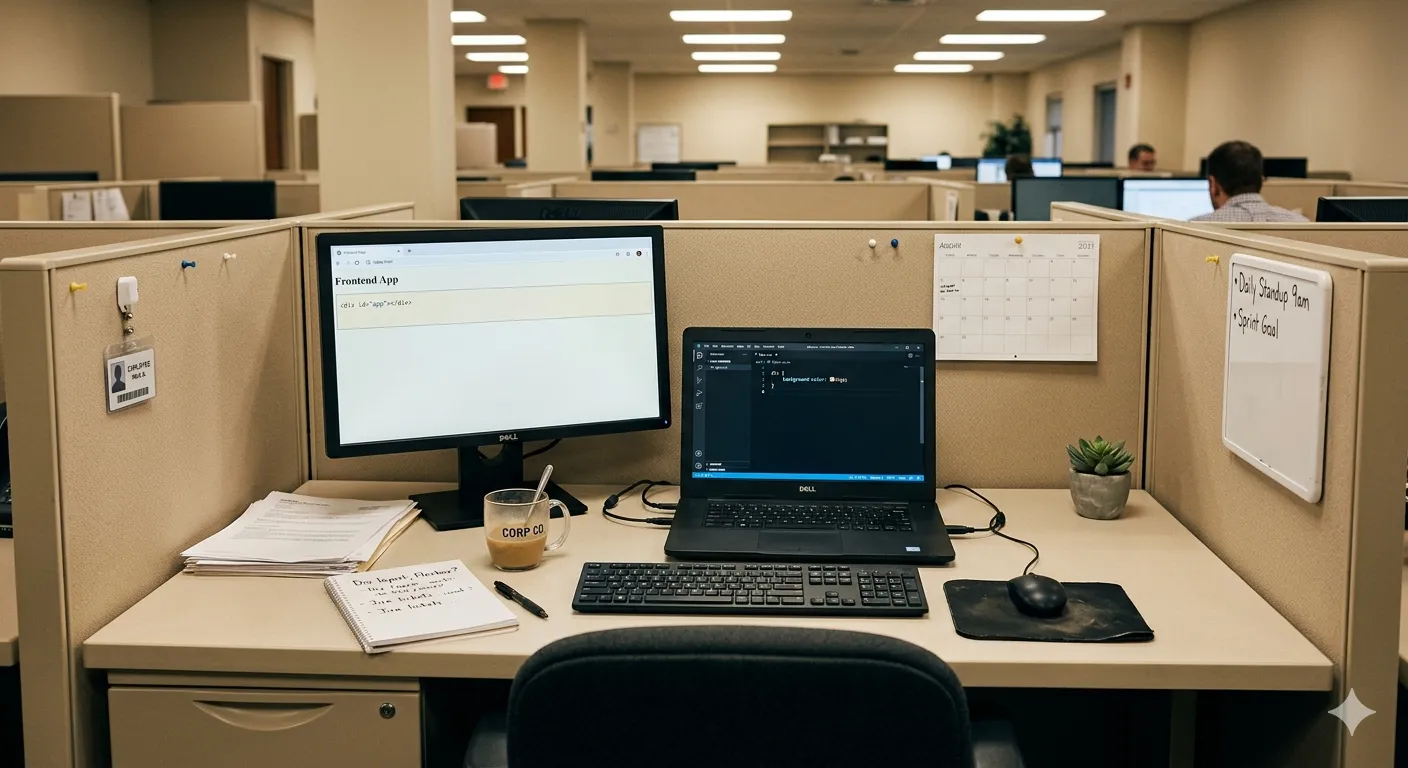
Datapoint Solutions occupied the second floor of a office park in Columbia, between a podiatrist and a business that sold promotional pens. David was given a cubicle near the men’s room and a Dell monitor with a dead pixel in the upper left corner that he grew to think of as a companion. His manager was a heavy man named Phil who called CSS “the styling stuff” and who once, in a moment of unusual candor, told David that the secret to a long career was to never be the smartest person in the room or the dumbest.
David built forms. He built many, many forms. He built forms for entering purchase orders and forms for requesting time off and forms for submitting inventory discrepancies that no one would ever read. He learned to center a div in the manner of his era, which is to say badly, and then with floats, and then with Flexbox, and then with Grid, each time believing that the final solution had arrived and each time being wrong. The forms were ugly, and then less ugly, and then merely unremarkable, which in the world of enterprise software passed for a kind of beauty.
He stayed at Datapoint for seven years. He did not think of them as seven years. He thought of them as the period during which he learned what he knew, though what he knew was difficult to name.
There was, briefly, a woman.
Her name was Christine, and she worked in Quality Assurance, and she had a way of filing bug reports that David found unexpectedly precise and gentle, as though she were correcting a child’s homework with care not to discourage. They ate lunch together in the break room for several months. They saw a movie. They saw another movie. One evening in her apartment she showed him a watercolor she had painted of a heron, and David said it was nice, and meant it, but could think of nothing further to say. The silence that followed was not uncomfortable exactly, but it had a quality of completeness, as if they had both arrived at the same conclusion without needing to speak it.
She left the company that spring for a position in Denver. They exchanged emails for a while, then didn’t. Twenty years later, her LinkedIn profile would surface in his “People You May Know” suggestions, and he would look at her photograph — older, smiling, the same careful eyes — and feel something that was not quite loss, because he had never been sure he’d had anything to lose.
The frameworks came and went like weather systems.
He learned jQuery when it was the future and forgot it when it was the past. He learned AngularJS and then was told that Angular was something else now. He learned React because a blog post told him to, and spent a weekend in his apartment trying to understand the virtual DOM, eating cold cereal from the box, the blinds drawn against a Saturday he had no use for. He understood it eventually — not deeply, not the way the people on Twitter seemed to understand it, with their conference talks and their open source libraries that had stars in the thousands — but well enough to use it, well enough to build the components that were asked of him, well enough to keep his job.
He read the discourse. He followed the arguments about state management, about CSS-in-JS versus utility classes, about server components and hydration strategies, and he found that he had no opinions, or rather, that his opinions were so mild as to be invisible, like a seasoning added in quantities too small to taste. He used whatever the team used and learned it without complaint and forgot it when it was time to learn the next thing. This was not, as some might suppose, a mark of indifference. He cared about his work the way a bricklayer cares about a straight wall — not because the wall is beautiful, but because it would be wrong for it not to be straight.
He moved between companies with the unhurried regularity of a man changing trains. After Datapoint there was Corbin & Associates, which built websites for car dealerships. Then there was NovaBridge, which did something with logistics that David never fully understood. Then Greenline Digital, Apex Collaborative, Trident Systems Group. The names varied. The Jira boards did not. He was always assigned to the frontend. He was always adequate.
At Greenline, a junior developer named Marcus asked him once how he had stayed in the industry for so long without burning out. David considered the question.
“I don’t know,” he said. “I just keep showing up.”
Marcus nodded as though David had said something profound, and David wished he could have been the kind of man who had said something profound, but he was not. He was the kind of man who kept showing up.
His mother died in 2028. He drove to Hagerstown on a Friday and sat in the hospital room and held her hand, which was lighter than he expected, like holding a small arrangement of sticks. She told him she was proud of him, and he knew she meant it, and he also knew that she had never quite understood what he did. “He works on the internet,” she had told her friends for thirty years, and that was close enough. He drove back on Sunday and opened his laptop and fixed a padding issue on a checkout page that had been bothering him since Wednesday. The work was there, as it always was, steady and unasking, requiring nothing of him but his attention, which he gave.
He had a 401(k) that was smaller than it should have been and an apartment with a Le Creuset Dutch oven that he used every Sunday to make a soup or a stew, which he ate for most of the week. He had a dog for four years, a beagle mix named Pixel, who died of a tumor, and after that he did not get another dog. He had a GitHub profile with a green contribution graph that showed moderate activity, like a field that has been planted but not abundantly. His most-starred repository had eleven stars, one of which was his own.
Somewhere in his middle years — he could not have said exactly when — a change came over the work that he did not fully understand. The young developers spoke of things he recognized but could not feel: of craft and of passion, of building in public, of personal brands. They had portfolios with animations and blogs with titles like “What I Learned Building a Design System from Scratch.” They live-streamed their coding sessions. They had audiences.
David had none of these things. He was, he understood, the kind of developer who existed in the background of other people’s careers — the one who fixed the accessibility issues and updated the dependencies and made sure the date picker worked in Safari. He did not resent the younger developers. He admired them, in his way, as one might admire birds for their ability to fly without seeming to think about it. But he knew he was not one of them, and had never been, and that whatever it was they possessed — that easy, public confidence — had been left out of him, not cruelly, but as a simple fact of his composition, like a color missing from a palette that still manages to paint.
In his last year, he was contracted to build a form.
It was, in its way, the finest form he ever built. It was for a small medical practice in Rockville — a patient intake form with conditional fields and accessible labels and validation that guided the user without scolding them. He spent three weeks on it. He tested it on screen readers. He tested it on old Android phones he bought from a thrift store. He adjusted the tab order until it felt like a conversation, each field leading to the next with a logic that was felt rather than seen.
No one remarked on it. The client said it looked “clean,” which was the highest praise David had ever received, and he accepted it with the faint, private satisfaction of a man who has done a thing well and knows it and needs no one else to know it.
He died, as has been said, on a Tuesday.
The coworking space manager found him the next morning, slumped slightly forward, his glasses on the desk beside his keyboard. His browser had three tabs open: a Stack Overflow question about CSS grid alignment that he had not needed to ask because he knew the answer already but had opened out of habit, a weather forecast for the coming weekend, and the patient intake form, still open in development, the cursor blinking in the empty field where a name would go.
He was buried in Hagerstown beside his mother. A few colleagues from various periods of his career attended the service, though most learned of his death through a brief message in a Slack channel that was archived the following quarter. His code, of course, survived him — not dramatically, not as a monument, but in the way that all code survives: quietly, temporarily, running on servers he would never see, serving users who would never know his name, until the day it was rewritten by someone else, and then it was gone.
But for a while it worked.
For a while, the forms were straight and the labels were clear and the tab key moved where you expected it to move, and if you did not notice — if you filled in your name and your address and your date of birth and clicked Submit without once thinking of the person who had made it possible for you to do so — that was all right.
That was all right.